Simulation
We always factor in safety
We provide precision and efficiency for projects across a wide range of industries.
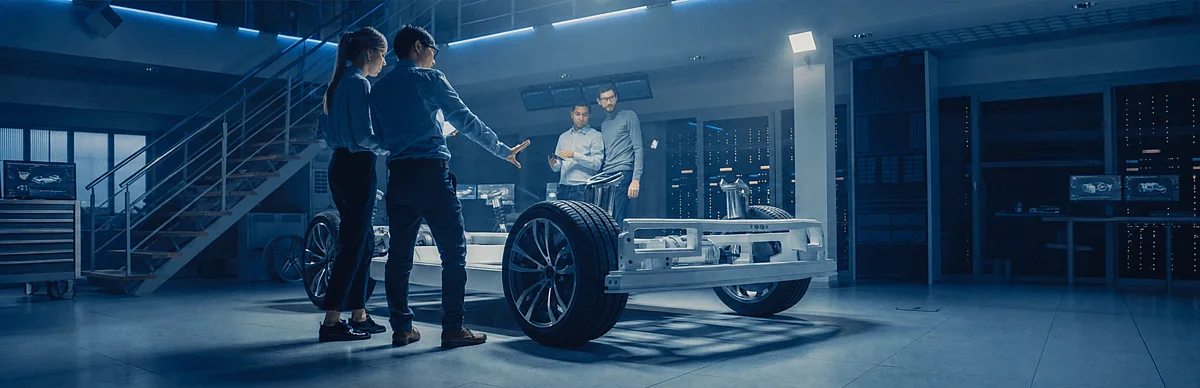
Our Simulation division provides comprehensive expertise in the digital analysis and optimization of complex systems. We develop customized solutions for all phases of product development with a broad range of services, including computational fluid dynamics (CFD) simulation, crash simulation, modal analysis, and strength and stiffness analyses.
As an experienced development service provider, we support simulation projects from initial concept to production readiness.

Strength and stiffness analyses
We examine the stiffness and strength of body components, battery housings, doors and add-on parts as well as cockpit modules. We take into account both local and global load cases as well as dynamic requirements such as NVH (noise, vibration, harshness). Our simulations enable the early identification and optimization of weak points.
Our expertise in stiffness and strength simulation is evident in numerous customer projects, as well as in the award-winning “3i-MQT” project, an innovative concept for an additively manufactured aluminum modular cross member.


Flow simulation (CFD)
We use computational fluid dynamics (CFD) to analyze and optimize flow and thermodynamic processes. From the flow-side design of air ducts and air conditioning systems to the simulation of heat transfer and the aerodynamic optimization of vehicle components such as bumpers or rear spoilers.
Optimization
Our optimization approaches range from topology and topography optimization to lightweight design potential analyses and the development of innovative material concepts. Using meta-model-based methods and multidisciplinary optimization, we ensure a balance between weight, strength and cost.

Special projects and interdisciplinary applications
In addition to the classic fields of application in the automotive sector, the expertise is also used in interdisciplinary research projects. Examples of this include the virtual clinical study“VirtuS” for fracture analysis in medical technology and the CO2-HyChain project for lightweight construction and CO2 reduction.
- Modal and PSD analyses to assess vibration behavior and dynamic load capacity
- Simulation of conjugate heat transfer between solids and fluids, including steady-state and transient analyses
- Automation and scripting to increase efficiency in development processes
Our focus is on detailed analysis and optimization. With in-depth expertise, state-of-the-art technologies and a multidisciplinary approach, we create added value that goes beyond individual disciplines. Together, we will bring your projects safely and efficiently to their destination - for sustainable success.

ANSWERS TO FREQUENTLY ASKED QUESTIONS
We accompany projects from the concept idea to series production. Simulation is a continuous tool for validation and validation. Through early digital analyses, we identify weak points before they become expensive in the physical prototype.
Our range of services includes crash and safety simulation, structural and stiffness analysis, fatigue strength, NVH (noise, vibration, harshness) calculations, CFD flow simulation as well as thermal and thermodynamic analyses. Optimisation methods such as topology and topography optimisation are also part of our scope of services.
We simulate high-speed and low-speed crash scenarios, pedestrian protection and occupant safety – always on the basis of legal and manufacturer-specific requirements. We rely on industry-leading simulation tools (solvers) such as LS-Dyna, PAM-CRASH, Radioss and Abaqus. In this way, we ensure that vehicles achieve maximum active and passive safety before a physical crash test takes place.
We analyze and optimize flow and thermodynamic processes – from the design of air ducts and air conditioning systems to heat transfer simulations and the aerodynamic optimization of vehicle components such as bumpers or rear wings. For these complex flow simulations, we use established tools such as OpenFOAM and StarCCM+.
Our optimization approaches range from topology and topography optimization to lightweight construction potential analyses and the development of innovative material concepts. Through metamodel-based methods and multidisciplinary optimization, we achieve the best balance of weight, strength and cost. The success of this simulative approach is demonstrated by our multi-award-winning innovation projects: the 3i-MQT (a multifunctional aluminum module crossmember made of additive metal manufacturing) and our ultra-lightweight seat with a structure made of xfk in 3D.
Yes – we investigate the stiffness and strength of body components, battery housings, doors, add-on parts and cockpit modules. Tools such as OptiStruct and FemFat help us to accurately map both local and global load cases as well as dynamic requirements.
Yes, our simulation expertise is also used in interdisciplinary research projects. Examples include the virtual clinical study "VirtuS" on fracture analysis in medical technology and the CO2 HyChain project in the field of lightweight construction and CO2 reduction.
Durch Automatisierung und Scripting (insbesondere mit Python) reduzieren wir repetitive Aufgaben im Entwicklungsprozess erheblich. Zudem binden wir leistungsstarke Preprocessing tools wie ANSA, Hypermesh, Primer, Generator und Loco nahtlos in unsere Workflows ein und verwenden darüberhinaus Postprocessing-Tools wie Animator4 oder META. Das ermöglicht es unserem Team, sich auf die eigentliche Analyse und Optimierung zu konzentrieren – und liefert unseren Kunden schneller belastbare Ergebnisse.