Automotive
Engineering expertise for mobility
As an engineering partner with over 30 years of experience, we support OEMs and suppliers in addressing key challenges: new powertrain concepts, increasing electrification, software-defined vehicles, shorter development cycles, and rising demands for sustainability, quality, and cost efficiency.
Our roots lie traditionally in vehicle development. Today, we combine this expertise with modern methods, digital technologies, and interdisciplinary systems engineering.
The result is practical, industrially viable solutions across the entire product lifecycle—from the concept phase to series production.
The methods and processes developed in the automotive industry continue to form the foundation of our work to this day. We successfully apply requirements for quality, safety, on-time delivery, complexity management, and production readiness to other industries such as defense, construction, manufacturing, and digital product development.
Our customers particularly value:
- A deep, holistic understanding of vehicles and systems
- Robust, transparent development processes
- Efficient scaling through well-coordinated, interdisciplinary teams
- Reliable implementation of complex requirements on time, on budget, and to the required quality standards
- Many years of experience in technologically demanding development environments
Structures, concepts, and systems—all from a single source
For decades, we have been developing technically sophisticated vehicle and system structures—ranging from individual components to complete vehicle systems. Our focus is on robust designs, efficient load paths, and the targeted optimization of weight, installation space, costs, and performance.
Engineering Focus Areas:
Concept development, variant studies, and feasibility analyses
Parametric 3D design and system development
Development of body, structural, and system components
Stiffness, strength, and service life analyses
NVH, CFD, and thermal management simulations
Targeted optimization of weight, installation space, costs, and performance
Comprehensive technical documentation and documents optimized for manufacturing and assembly
Increased Efficiency Through In-Depth Analyses
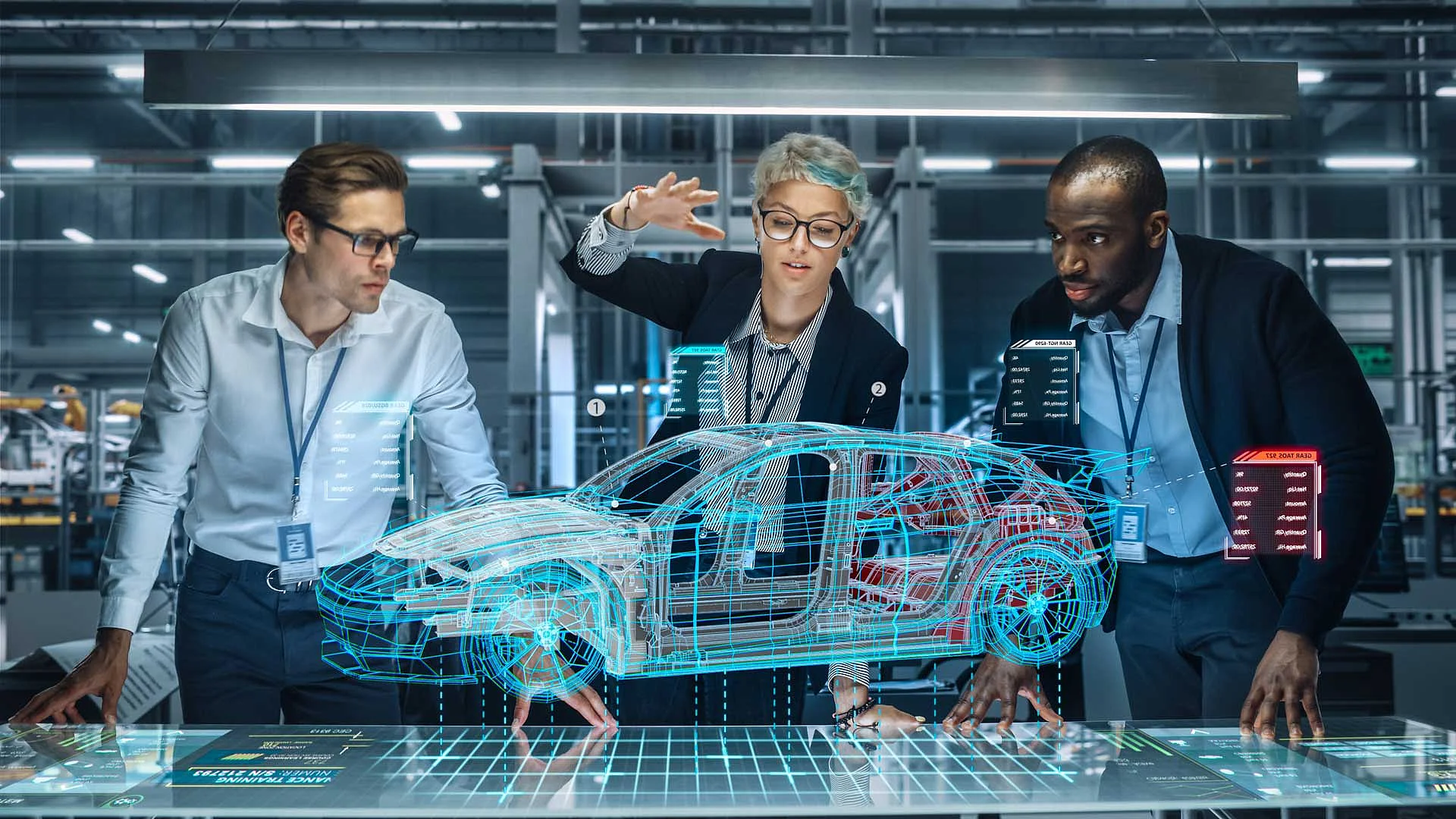
Digital development methods enable well-informed decisions early in the project and significantly reduce technological risks long before the first physical prototype is built.
Lightweight construction is one of the key drivers of efficiency, range, sustainability, and cost-effectiveness. Using simulation-based methods, we create a robust foundation for decision-making in development, validation, and optimization.
Our services range from multi-material design and topology optimization to the virtual validation of complex structures and systems—always with an eye toward mass production processes, manufacturability, and costs.
Engineering Focus Areas:
Structural simulation and virtual validation
Lightweight and multimaterial designs
Topology optimization
Crash and safety analyses
NVH simulations
CFD and thermal management
Lifespan and structural integrity analyses
Modern vehicles are software-defined systems. Electrical and electronic architectures, sensors, actuators, power supply systems, and control units form the technological backbone of current and future vehicle platforms.
We develop and integrate Electric and Electronic systems from architecture definition through validation—with a focus on robust system design, secure integration, and reliable functionality.
Engineering Focus Areas:
E/E system architectures and vehicle electrical systems
System and function development
Integration of electrical, electronic, and software systems into complete vehicles
Architecture definition and system design
Functional and interface validation
HiL and SiL test benches
Verification and validation
Implementation of regulatory requirements and standards
Our focus is on robust, reliable, and scalable systems that can be securely integrated into existing vehicle architectures.
The development of complex systems requires a comprehensive understanding of requirements, architecture, and system behavior.
We work methodically in accordance with established systems engineering standards and follow the principles of ISO/IEC 15288. This ensures that requirements are consistently derived, implemented, and verified.
To this end, we rely on an end-to-end toolchain that ensures transparency, consistency, and traceability across all development phases.
Our focus is on:
Requirements and interface management
System architecture and integration
Verification and validation
Change and configuration management
Traceability throughout the entire product lifecycle
Today, vehicle development involves coordinating complex technologies, numerous stakeholders, and demanding schedules.
We support development projects from pre-development through series development to industrialization and market launch. In doing so, we combine technical expertise with methodical project management and ensure transparency regarding quality, costs, and deadlines.
Our project management methods combine traditional, hybrid, and agile approaches and are tailored to the requirements of each project.
Our focus areas are:
Project and program management
Schedule, milestone, and synchronization management
Stakeholder and committee management
Risk and configuration management
Maturity and change management
Reporting and escalation procedures
Supplier management and partner coordination
Digital technologies expand traditional development processes and create new, efficient, and fast options for analysis, validation, and decision-making.
We develop connected digital twins, real-time 3D applications, and customized software solutions to support development, production, and operations.
In addition, we use automation and AI approaches to make development processes more efficient, transparent, and scalable.
Our areas of focus:
Digital twins
Mixed reality environments
AR-assisted maintenance and inspection
Real-time design reviews
Virtual approval processes
Engineering automation
AI-assisted development support

The automotive industry is one of the most technologically demanding development environments in the world. It is precisely in this field that we have spent decades building up methods, processes, and expertise that today form the foundation for successful projects across a wide range of industries.
For us, our experience in the automotive sector is much more than just our roots—it is the benchmark for quality, efficiency, and technical excellence.
Our customers benefit from:
Over 30 years of experience in vehicle development
A deep understanding of complex technical systems
Established quality and development processes
Interdisciplinary teams comprising mechanical engineering, E/E, software, and project management
Rapid scaling of development resources
Engineering expertise that has also proven itself in defense, construction, and other industries